Femina Mortem
Choir, c.7’, 2025.
Commissioned by the West Australian Symphony Orchestra, through the support of Prue Ashurst.
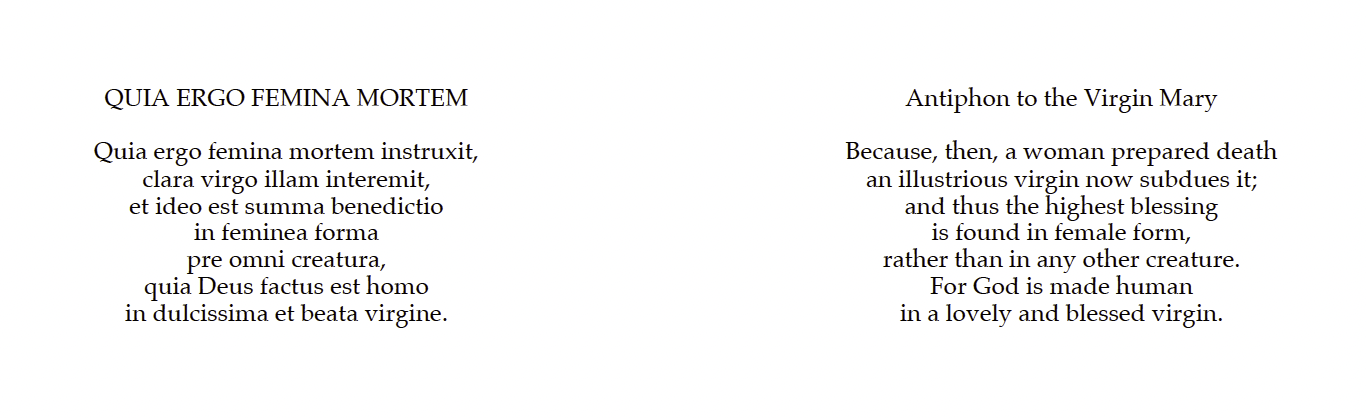
Based on Hildegard von Bingen’s antiphon ‘Quia ergo femina mortem instruxit’
Femina Mortem is based on the text from Hildegard von Bingen’s antiphon Quia ergo femina mortem instruxit, which roughly translates to ‘because, then, a woman prepared death’.
What drew me to this short, evocative text is Hildegard’s celebration of feminine power as she reframes women’s role in Christianity from one of guilt to one of blessing and redemption. In the text, Hildegard contrasts Eve, who introduced death through original sin, with Mary, who brought life through Christ. This follows the medieval "New Eve" theology, where Mary’s obedience reverses Eve’s disobedience.
In just seven lines Hildegard elevates women with a narrative that is at once complex and nuanced. It’s boldness instantly resonated with me, and one of my first musical decisions was to layer the text with independent soprano and alto lines. These layers, often in canon, slowly carry the music and narrative forward, while the tenors, basses and organ softly ground it all with depth and contrast. The piece, for the most part, is quite sustained, breaking down and drawing out the words by their syllables. This renders the text indiscernible at times, instead drawing attention to the subtle shifts in tone as vowels slowly change.
To pay homage to Hildegard and to honour her original antiphon, I incorporated melodic fragments from Quia ergo femina mortem instruxit at the end of my piece. Over a steady, chant-like texture, solo soprano voices echo the words; “mortem” (death), “femina” (woman), “summa benedictio” (highest blessing), “virgo” (virgin), “illam interemit” (she destroyed it). Hildegard’s phrases float freely, emerging out of the music with clarity and purity. The piece ends with the final phrase “pre omni creatura” (rather than in any other creature), taken from “and thus the highest blessing is found in female form, rather than in any other creature”. I found the melody for this phrase worked beautifully as a final statement, with the words expressing the boldness and directness that first drew me in.
Hildegard von Bingen (1098–1179): German Benedictine abbess, composer, writer, mystic, and polymath. A renowned figure of the Middle Ages, Hildegard made lasting contributions to music, theology, medicine, and natural sciences.
Listen to an excerpt:
Premiere performance by the St Georges Cathedral Consort conducted by Joseph Nolan. Recording courtesy of ABC Classic.